

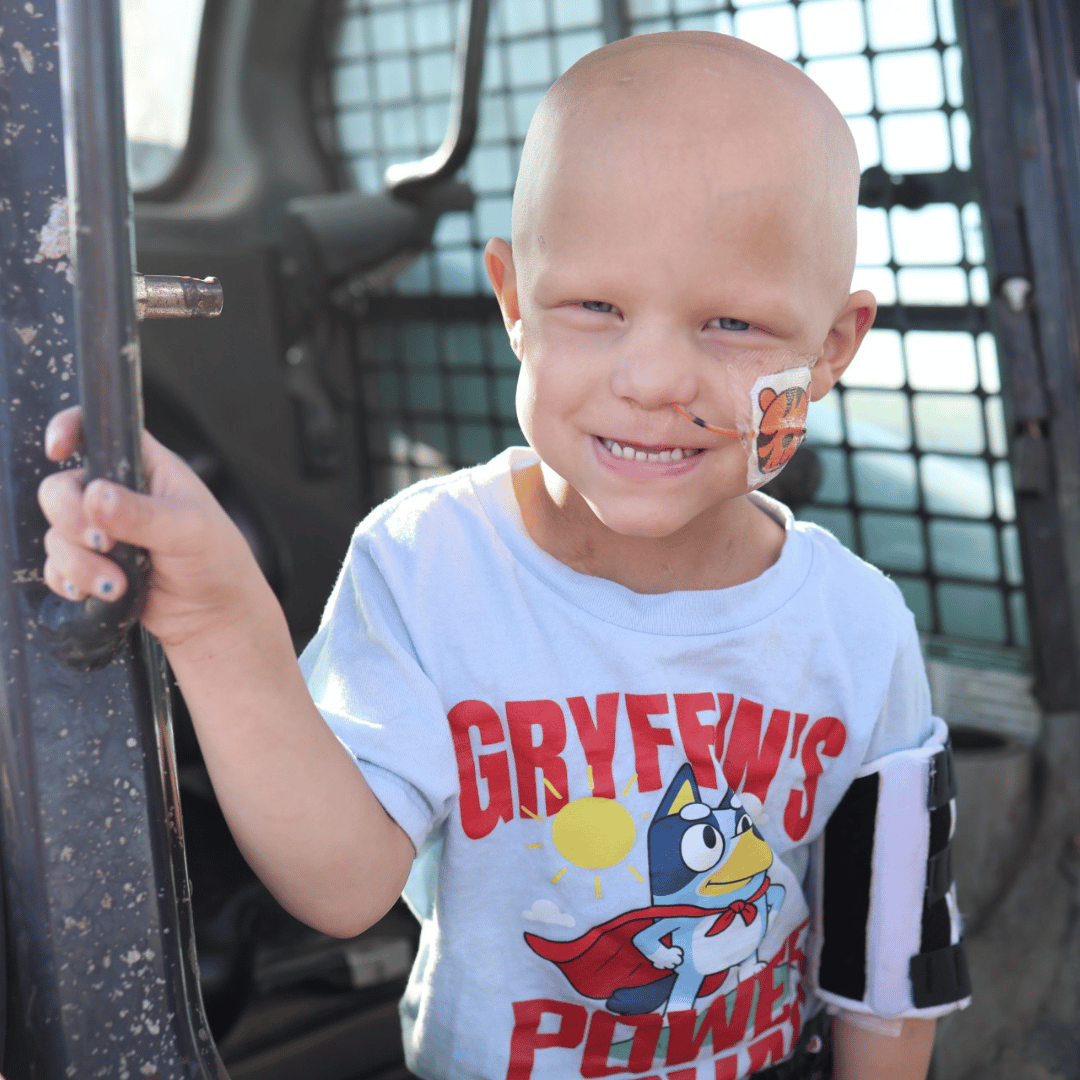
All-Star Gryffin
Diagnosis: Trilateral Retinoblastoma (Bilateral Retinoblastoma + Pineoblastoma)
When your little boy has a rare type of brain cancer and the odds are stacked against him, you do everything in your power to make precious memories. For four-year-old Gryffin, that means camping with his family so he can be his silly self, laughing and playing with his big brother.
But camping costs money, between gas for the truck, food, and campground fees. So, when they received an Orange Envelope from Pinky Swear Foundation filled with a gift card and Letters of Encouragement, and Gryffin was pleading to go camping, his parents were able to say yes.
“It was between rounds of chemo, and he wanted to go camping badly,” said Gryffin’s dad, Kenny. “So, we used part of the gift card for camping and the rest of it for food and groceries. We thought, ‘We have this gift; we want to give him the memory of it.’ Let's do something meaningful.”
Gryffin’s cancer journey began at birth. He was diagnosed with retinoblastoma, a type of eye cancer, at just seven days old. Retinoblastoma is a rare childhood cancer, with only an estimated 300 children diagnosed each year. Of those children, only about 15 will go on to develop what is known as trilateral retinoblastoma, retinoblastoma in the eyes along with a separate brain tumor. His parents were somewhat prepared; Kenny carries a gene that can be passed down to his children. Their elder son did not have it, but when Gryffin opened his eyes a few days after birth, they knew Gryffin did.
For two years, Gryffin faced retinoblastoma. The family traveled to frequent appointments, more than two hours from home, and they remained hopeful. Every new tumor responded to treatment, and every treatment got easier for Gryffin. After being under anesthesia twenty-seven times, Gryffin was finally declared in remission. Slowly, his family began to breathe a little more easily.
There were still lasting effects from cancer in both his eyes, and regular checkups would remain part of their lives, but for the first time in two years, they were beginning to find a sense of normalcy again. They truly believed the hardest chapter of Gryffin’s cancer story was behind them.
Fourteen months later, on April 28, 2025, the family was at Mayo Clinic in Rochester, MN camping for Gryffin’s routine MRI. It took longer than usual, so by the time they were called back to see him, his mom, Ashlee, had received a notification that Gryffin’s results were ready. When she opened them, the first words she saw were, “consistent with pineoblastoma.”
Kenny looked over at Ashlee and knew immediately what she was reading. Kenny reflected on that exact moment in the hospital room. “I immediately thought, I have to keep Ashlee calm; we have Gryffin’s brother with us, and Gryffin is still trying to wake up,” explained Kenny. At that very moment, the family learned the cancer had returned. Gryffin had pineoblastoma, a brain tumor.
“I was terrified, but I was not going to let my fear control me. I had my family to think of,” Kenny said.
It was late in the day, so there were no oncologists around. They decided to pull their camper home. Kenny drove the family and their camper through one of the worst thunderstorms they have ever driven through, and during that drive, they received a call from Gryffin’s new oncologist. The doctor’s words were: “He is critical, and we don’t know what we are going to do. The team will meet in the morning.”
Kenny and Ashlee had to act quickly to accommodate the appointments that were suddenly added to their schedule that week. They also learned that chemotherapy, possible surgeries, three stem cell transplants, and other treatments were ahead.
Kenny worked full-time as a software developer while also consulting nights and weekends. Ashlee worked full-time as a Director of Childcare and was completing her master’s degree in school counseling.
Once home, they began making a plan. Because Kenny was the family’s primary income earner and carried their health insurance, they knew he needed to continue working as much as possible. For the first several months of treatment, Ashlee became Gryffin’s primary caregiver. While her employer was incredibly supportive, the loss of income quickly began to take a toll on the family’s finances.
Knowing they needed to continue working as much as possible, Kenny and Ashlee chose to have Gryffin’s initial treatments at a local hospital and his three stem cell transplants at a hospital ninety minutes from home, rather than three hours away. However, due to insurance requirements, Gryffin’s first round of chemotherapy had to be completed out of state, adding even more travel expenses to an already difficult financial situation.
Throughout treatment, Kenny and Ashlee tag-teamed between home and the hospital, often passing like ships in the night. Some months, they only saw each other for a few days. Both continued working full-time, while Ashlee continued her master’s program, and Kenny continued his consulting work. At the same time, they were caring for their other son, who was just 13 months older than Gryffin.
“Coordinating work schedules, daycare, preschool drop-offs and pick-ups, weekly night classes, hospital stays, and everything in between was exhausting, but it had to be done,” Kenny said. “Looking back, I’m not sure how we did it; how one of us was always available, always home, and always there to care for our other son, who was just four years old at the time.”
Because of the All-Star Fund Program, Pinky Swear Foundation was able to step in and pay the family’s mortgage. For a few weeks, that support allowed Kenny to step away from his second job and gave the family something they desperately needed: time together.
“Giving the kids some sense of normalcy was so important. Otherwise, you would go nuts,” Kenny explained. “When Pinky Swear paid the mortgage, I didn’t have to work those weekends or nights, allowing us to be there for both our sons when they needed us most. It relieved the worry of having to work extra just to make ends meet.”
The mortgage payment gave the family more than financial relief; it gave them time together during a period when time felt especially important. Gryffin’s diagnosis is extremely rare and aggressive, and his future is uncertain.
Through it all, Gryffin is the kind of kid who always tries to be as happy as he can be. Even on hard days, his goal is to laugh and make others laugh. He is also compassionate and caring.
On Christmas Eve afternoon, he announced that he wanted to take cookies to the kids who had to spend the holidays in the hospital. So, Kenny drove to the grocery store right before it closed and bought all the cookies they had left. They made the trip to the hospital, and Gryffin got his wagon, loaded it up, and handed out the cookies to the kids. We can’t help but see a little bit of our founder, Mitch, in Gryffin’s compassion for others.
The reality for Gryffin is that he has exhausted his treatment options. If he relapses, the conversation will be about hospice care. The aftermath of his cancer treatment has left him with memory and hearing loss, and behaviors associated with six weeks of brain and spine radiation. When they can, they go camping.
“We are deeply grateful for the compassion, generosity and hope that Pinky Swear brings to families like ours. Thank you,” concluded Kenny. “No matter how big or small a donation, it all makes an impact."